My first internship when I was 19 and still in college (well, failing out at that point but that's another story...) was at a small consulting company where every desk had a 286 clone running MS-DOS 3.3.
We spent our entire days in SuperCalc 3 and dBase III, and some of the fancier staff actually got to use 1-2-3. I think we used both because 1-2-3 had copy protection and SuperCalc didn't? But 1-2-3 was clearly better.
I had to train the older staff members on how to use a mouse. One person thought you had to reboot the computer if the mouse cursor wouldn't go far enough in one direction without reaching the end of your physical desk area -- they didn't know you could Lift The Mouse Off The Desk to move the physical mouse to a better location without moving the cursor. It is truly hard to explain just how newfangled all this technology was back then in a small office.
A big breakthrough for us was switching from dBase to "Clipper" which was basically dBase on the backend but with the ability to write text-mode UI code, so you could build nice purpose-built data-centric applications for clients.
There was a LOT of data entry, digitizing the stops and routes of city transit maps into dBase and these DOS spreadsheets. The keyboard shortcuts were SO FAST and when we eventually moved to Windows 3 in 1991, I always enabled the 1-2-3 keyboard shortcuts in Excel. I still remember some of them.
I imagine there's nothing unique about my experience: these types of tasks were surely replicated all over the business world, with interns and staff getting their first taste of spreadsheets and programming languages in these powerful, tiny DOS programs.
I'll skip our brief foray into the dead end that was OS/2 2.0 :-)
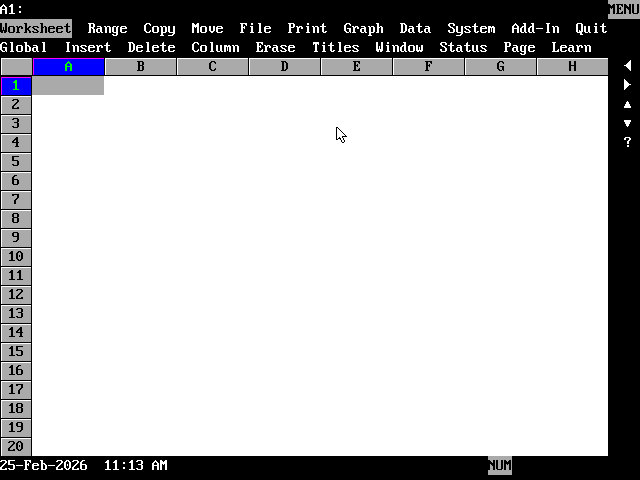
That said, DOSBox's TrueType fonts threw me off. It looks great of course, but it's similar to listening to Synthwave: there are some familiar elements from the era it represents, but it still feels alien.
I first learned about spreadsheets on a TV show in Turkey[1] that I believed demoed Lotus 1-2-3, and my 10 year old mind was blown! What an elegant, unique, and flexible way to model computation! We take spreadsheets for granted today, but I think it's one of the greatest inventions in computing history.
[1] https://youtu.be/tq7auBjEIU4?si=ByTvm2bIT_Dpklqz&t=1451
I think that’s a combination of information underload and longer lead times.
Information underload: back then, you have a new magazine, at best, every week, if you could afford to buy multiple or had access to a good library. That meant you were willing to spend time looking at ads, and they didn’t even have to look nice. Old Bytes had many more or less type-written ads, for example.
Longer lead times: if you published in, say, Byte or Dr Dobbs, which appeared monthly, your sales department had a month to prepare the looks of each ad (pricing for hardware likely would be filled in at the last moment). Nowadays, they could take that time, too, but they also could have one published in a few hours, create another tomorrow, pull the poorer performing one the day after tomorrow, etc.
If live is that frantic, can you afford to spend a week on an advert?
The real reason ads look shittier now is the marketing world shifted their investment from the ads themselves to ad targeting. You just don’t need to make great ads if you can shove them in the face of the most receptive people at the right time. It’s also not feasible to make a few great ads when your marketing team has 8 different approaches tailored to specific demographics in multiple languages.
I flip-flop on using TrueType in DOSBox-X for the blog. I know there is a "purity" element to retrocomputing in certain corners, and I do appreciate that. But since I'm confined to emulators, I guess I feel like I might as well take advantage of what they have to offer.
I really like that Turkish video. Do they mention the name of that particular spreadsheet?